Hey there! As a supplier of butterfly valves, I often get asked about the flow characteristics of these valves. So, I thought I'd take a few minutes to break it down for you in a way that's easy to understand.
Let's start with the basics. A butterfly valve is a type of quarter - turn valve that uses a disk to control the flow of fluid through a pipe. The disk is mounted on a shaft in the center of the valve, and when the valve is opened, the disk rotates 90 degrees to allow fluid to pass through. When it's closed, the disk blocks the flow.
One of the key things to understand about the flow characteristic of a butterfly valve is that it's non - linear. What does that mean? Well, most of the time, the relationship between the valve opening (the angle of the disk) and the flow rate isn't a straight line. At the beginning, when you start to open the valve from a fully - closed position, even a small movement of the disk can cause a relatively large increase in the flow rate. But as the valve gets closer to being fully open, you need to open it a lot more to get the same increase in flow.
For example, when the valve is only 10% open, you might see a 30% increase in the flow rate. But when the valve is 80% open, opening it another 10% might only increase the flow rate by 10%. This non - linearity can be both an advantage and a disadvantage, depending on your application.
Advantages of Non - Linear Flow Characteristics
-
Good for On - Off Applications: In systems where you mainly want to either completely open or completely close the valve, the non - linear flow characteristic is great. You can quickly start or stop the flow with just a small movement of the valve handle. For instance, in a simple water supply system for a small building, you can use a Handle Manual Wafer Center Butterfly Valve D71X - 16 to easily turn the water on or off.

-
Precise Flow Control at Low Flow Rates: When you need to control very low flow rates, the initial steep part of the non - linear curve allows for more precise adjustment. You can fine - tune the flow by making small changes to the valve opening. This is useful in chemical dosing systems, where you need to add a very small and accurate amount of a chemical into a process stream.
-
Energy Savings: Since a small movement of the valve can cause a significant change in flow at the start, you don't need to use as much energy to operate the valve in some cases. This can lead to cost savings over time, especially in large - scale industrial applications.
Disadvantages of Non - Linear Flow Characteristics
- Difficult to Control at High Flow Rates: When the valve is almost fully open, it becomes harder to make small adjustments to the flow rate. A small change in the valve position can result in a large change in flow, which can be a problem in applications where you need very precise control of high - volume flows.
- Flow Instability: The non - linearity can sometimes lead to flow instability, especially in systems with sensitive equipment. Sudden changes in flow due to small valve movements can cause vibrations or other issues in the piping system.
Now, let's talk about some factors that can affect the flow characteristics of a butterfly valve.
Factors Affecting Flow Characteristics
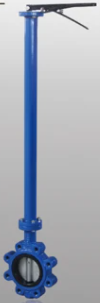
- Valve Design: Different types of butterfly valves have different flow characteristics. For example, a lug - type butterfly valve might have a slightly different flow pattern compared to a wafer - type valve. A Ggg40 Ggg50 Lug Type Butterfly Valve With Extension Stem is designed for specific applications where you might need to mount the valve between flanges and have more flexibility in installation. The shape and size of the disk also play a role. A thinner disk might allow for a more streamlined flow, while a thicker disk could cause more turbulence and affect the flow rate.
- Fluid Properties: The type of fluid flowing through the valve matters a lot. Viscous fluids, like oil, will have a different flow behavior compared to water. A more viscous fluid will flow more slowly and might require more force to move through the valve. Also, the temperature of the fluid can change its viscosity. For high - temperature applications, you might need a Ductile Iron Cast Iron Carbon Steel Body EPDM PTFE NBR Soft Seal Wafer Manual High Temperature Butterfly Valve to ensure proper sealing and flow control.
- Piping System: The size and layout of the piping system can impact the flow through the valve. If the pipes are too small or have a lot of bends and fittings, it can create back - pressure and change the flow characteristics of the valve.
How to Optimize Flow in Butterfly Valve Applications
- Proper Sizing: Make sure you choose the right - sized valve for your application. A valve that's too big or too small won't work as efficiently. You need to consider the maximum and minimum flow rates you expect, as well as the pressure drop across the valve.
- Use of Actuators: For applications where you need more precise control, especially at high flow rates, using an actuator can help. An actuator can accurately control the position of the valve disk, compensating for the non - linear flow characteristic.
- Regular Maintenance: Keep the valve in good condition. Over time, the valve can wear out, and the sealing surfaces can get damaged. This can affect the flow characteristics and lead to leaks. Regularly check and replace any worn - out parts.
If you're in the market for a butterfly valve, whether it's for a simple on - off application or a complex industrial process, we've got you covered. Our wide range of butterfly valves, like the ones I've mentioned above, are designed to meet different flow requirements and application needs. We understand the importance of getting the right valve with the right flow characteristics for your project.
If you're interested in learning more or want to discuss your specific requirements, feel free to reach out. We'd be more than happy to help you find the perfect butterfly valve for your application and guide you through the purchasing process.
References
- Perry, R. H., & Green, D. W. (1997). Perry's Chemical Engineers' Handbook. McGraw - Hill.
- Miller, D. S. (1990). Internal Flow Systems. BHRA Fluid Engineering.